EricThornton.net / Eric Thornton - Croatia Page
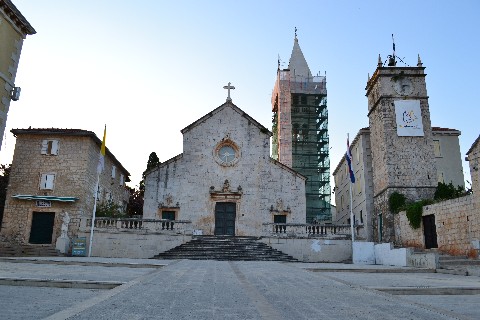
The parish church in Supetar with monumental stairs built in 1733, extended in 1887. Inside the church you can find the paintings of a local baroque painter Feliks Tironi and the baroque Pala of an unknown Venetian painter from 18th century
Supetar
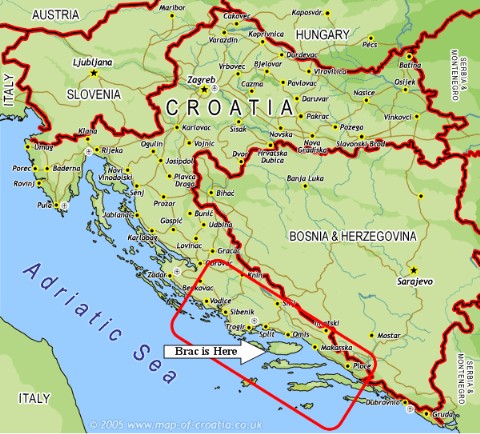
With more than 3000 inhabitants, Supetar is the main tourist resort and transportation center of the Island of Brac. As it is located on the northwest coast of the island, it is well connected with the mainland town of Split by ferry boats and also with other villages of the island by daily bus lines.
Supetar is a typical Dalmatian town, distinguished by a pictorial promenade with numerous fish boats and palm trees giving its center a characteristic Mediterranean charm. Beside bays with a fine pebble beaches, surrounded by tamarisk and pine woods, Supetar offers everything that a city can offer: cafes, bars, beach bars, numerous restaurants, dance terraces, disco club, tennis courts, surfing and diving school etc. You can enjoy its cultural monuments, various sports and recreation programs. There are lots of restaurants where you can taste local, Mediterranean cuisine as well as some other Croatian specialties. Despite the tourist open-mindedness of Supetar you can always find a quiet place where you can have a nice conversation over a glass of wine or just peacefully sit and enjoy the surroundings. A well-known Dalmatian hospitality is present on each corner.
The monumental sculpture in Split of the bishop that reads the Bible facing the northern walls of the Diocletian’s palace presents Grgur, the bishop of Nin. The sculpture was made by Ivan Mestrovic in 1929 and originally stood in the center of Peristyle untill 1954. Grgur Ninski was 10th century bishop that strongly opposed the Pope and official circles of the Church and introduced the Croatian language in the religious services after the Great Assembly in 926. Until that time, services were held only in Latin, not being understandable to the majority of the population. Not only that this was important for Croatian language and culture but it also made the religion stronger within the Croatian nation. The sculpture of Grgur Ninski is so popular that you’ll find smaller versions of it in squares in Nin and Varazdin as well. None of them is as monumental and big in scale as the original from Split. The bronze on Grgur’s toe is worn down since the local legend says it that you have to touch his toe each time you pass by if you want good luck and if you want your wishes to come true.
Split
The City of Split marks 1700 years since the beginning of the construction of Diocletian's Palace. Split, a city where every epoche since antiquity has left its traces, was conceived within the walls of the palace which was built by the Roman Emperor Diocletian as his private residence. The well-preserved palace has been listed as UNESCO's register of the worlds cultural heritage. During these 1700 years plus, Split has played an important role in Croatian history. Today, Split is the center of cultural and scientific life, with many institutions, museums, gallerys and theatres. Split is the second biggest city of Croatia. Due to its central position on the Adriatic coast and its exceptional environment, Split soon developed into the leading and biggest city of South Croatia, its large port, commercial and industrial center and an important European touristic resort. The present city of Split is an organic fusion of its antique heritage and of modern architecture, set up in the beautiful Mediterranean environment and full of a sober and thoughtful atmosphere of a big city.
Diocletian had this massive palace built to spend the last years of his life after abdicating on May 1, 305 AD. The bay is located on the south side of a short peninsula running out from the Dalmatian coast into the Adriatic, four miles from the site of Salona, the capital of the Roman province of Dalmatia.
ericthornton.net photograph
ericthornton.net photograph
ericthornton.net photograph
ericthornton.net photograph
ericthornton.net photograph
ericthornton.net photograph
Croatia's Beaches
Croatia's main tourist attraction has always been its beaches. The Adriatic coast and islands are lined with amazing beaches, abounding in natural harbors, with its countless bays, ports and marinas.
Croatia has an amazing 5,835km of coastline, 4,057km of which belongs to islands, cliffs and reefs. There are 1,185 islands in the Adriatic, but only about 50 are populated. The largest island is Krk (near Rijeka) which has a land area of 462 square km.
The climate is Mediterranean along the Adriatic coast, meaning warm dry summers and mild winters, with 2,600 hours of sunlight on average yearly - it is one of the sunniest coastlines in Europe!
ericthornton.net photograph
ericthornton.net photograph
ericthornton.net photograph
ericthornton.net photograph
ericthornton.net photograph
Eric Thornton: This Pirate Takes On All Ships